
I’m not big on New Year resolutions. I never have been. But back in 2024, I decided I was going live more intentionally, and, to that end, I decided that every single morning, I would set a clear intention for the day and write it in my bullet journal. While I didn’t remember every single day, I missed only one or two days each month, which still puts me at over 90% for meeting my daily goal of setting an intention.

Some intentions kept coming back, over and over again, to the point where, for 2025, I was able to identify three clear themes to focus on:
Honor my body
Go slowly
Be the guardian of my attention
Then, doing a words of the year exercise from Merideth Hite Estevez, I distilled those phrases to three words:
Healthy
Unhurried
Focused
And all year, I truly let those words be my guide. I increased my exercise habits and my Garmin fitness watch tells me I’ve rolled back my fitness age by a couple of years. I’ve talked myself out of a lifelong tendency to rush to the point where my husband—the slowest slow poke I’ve ever met—remarked one day in July how weird it was that I never seemed to rush him anymore and how much he appreciated it. And I’ve taken several concrete steps to reclaim my my attention from the economy that wants to monopolize it.
That said, these three areas of focus require my constant vigilance, so I am not choosing new words for 2026. Instead, I’m holding onto these and redoubling my efforts. I’m not a tattoo person, but I can almost imagine having these three words inked into my skin.
The hardest of the three: Focused
Last fall, the artist James Gurney shared an instagram post in which he wrote, “If the internet is based on search, what happens when people are no longer curious?” Apparently, he asked AI, and it’s response is an absolute punch in the gut:
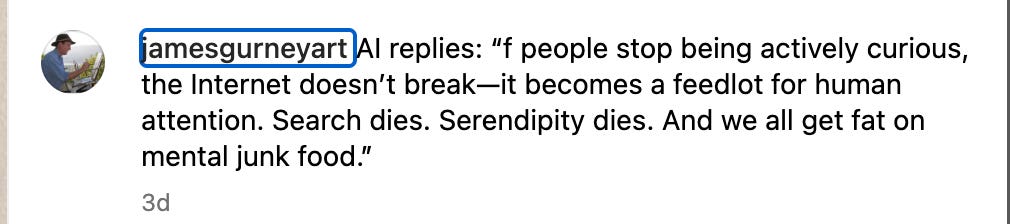
That’s a hell of a description for the endless, mindless scroll so many people seem currently trapped in. All summed up in a concise and upsettingly poetic nutshell provided by a machine that does not think but that only processes requests and data.
Tech companies would like us all to scroll as often as possible. The more we scroll, the more ads they can serve us, the more money they make because advertisers pay each type we click, whether or not we buy anything from those advertisers. And the more we click, the better the algorithms can assess what ads to show us next, so the ads get better and better and we click more and more and they make more money in an endless snowball of mindlessness. And, I’m guessing, the advertisers have found they make enough sales this way to keep investing in pay-for-click advertising, and so our lives become cluttered with cheap crap we do not need but that offers us fleeting satisfaction, one more dopamine hit in the daily flood of dopamine that leaves us over stimulated, stressed out, and always craving more.
In “Self-Reliance,” Emerson wrote, “Society everywhere is in conspiracy against the manhood of every one of its members.” We can easily update that for the twenty-first century: Modern society everywhere is a conspiracy to capture and monetize attention of every one of its members.” And if we extend “manhood” to “humanity” (which was sort of / kind of Emerson’s meaning1 in a world where language still deferred to masculine preferred), actually we are saying the same thing, because what is our humanity if we cede all our attention to algorithms?
As I have noticed the slow, steady, insidious creep of attention theft in my life over the past decade, I have taken steps to push them back. I think I am an unusually focused person by nature, and I had enough self-awareness to see my own attention being cut into pieces, and I did not like it.
Years ago, I disabled “autoplay” on YouTube. I hated how when one video ended another would begin to play automatically. It was serving me an endless buffet of bland sameness as it guessed what sorts of videos I might want based on those I already watched, and I hated it. Wasn’t the benefit of streaming over traditional media that I got to choose what I saw? So why was I being fed nonsense I hadn’t asked for? I have similarly disabled autoplay options on any streaming services where I could figure out how.
Over two years ago, fed up by my dysfunctional relationship with social media—I would delete and reinstall Instagram and Facebook a few times a week!—I discovered an app called ScreenZen, which is like my phone’s built in screen time limits on steriods, and I use that to set limits on anything that I used as a mindless, reflexive scroll: Email, news apps, social media. Suddenly my phone became a lot less interesting.
And yet I kept reaching for it. Without my usual apps, I kept finding myself opening Chrome, and on the home page, there would be these suggested stories, so I would scroll those, until the creepiness of their existence freaked me out enough to wake me up. What was I doing? Why I was I using a browser that was tracking every single thing I did, and why was I scrolling these dumb suggested articles and websites, most of which were click bait stupidity? Again, I hadn’t asked for them. I did a little digging and discovered that you can turn off suggested items in Chrome, so that all I see on the home page is a search button. Hallelujah. But I also disabled Chrome as my default browser and replaced it with DuckDuckGo, a browser that doesn’t track my data.
Then, in one small step towards maybe going back to a dumb phone, I got the Brick device that lets you dumb your phone for periods of time. Now it’s become a point of pride to see how long I can go without unbricking. When my device is bricked, I can access messages, phone calls, maps, and Spotify, and not much else. I’m back to listening to music again!
In addition to taking charge of the settings of my phone and platforms I enjoy but that could easily become bottomless pits of content, I also actively do things that take me away from screens: I take walks and bike rides without bringing my phone along. I do analogue activities that fully occupy my mind and hands so I can’t scroll: I paint, I play my guitar, I bake. For my creative writing, I use a notebook for drafting so I don’t get distracted by my computer. Little by little, I have clawed my mind back from the black hole of the endless of scroll.
Still, I know I have more work to do in this area of my life. I would like to be a person who gets home at the end of the day, puts the phone down in its designated phone spot and doesn’t pick up again until the next day.
I know I’m not ready to get rid of my smartphone entirely. I love the camera. I rely on the maps. I actually use my phone for a lot of simple, productive work tasks, too, much to the amazement of my students2 for whom phones are exclusively a fun toy and distraction box. So I’m not going to go full nuclear and revert to a dumb phone, but less, less, and less is the plan for 2026. I will be the guardian of my attention.
How have you noticed the mindless scroll affecting your life? Have you found ways to resist? I’d love to hear your thoughts in the comments!
Emerson was talking about humanity, but also, I think, about the gendered concept of manliness and what it means to be a man. I don’t know if that’s because the language conventions of his time limited his expressions and therefore constrained his thoughts or if he was consciously choosing to speak on manliness to the exclusion of femininity and humankind more broadly. Any Emerson scholars in the room?
At the start of the 2025-26 school year, when I had my students use their phones for a school task, I discovered that quite a lot of them had never set up email on their phones and even those who did had no idea how to attach something to an email on their phones. This amazed me. These so-called digital natives barely know how to use their devices, except as toys!
Great insight!