
The other day, one of my fellow English teachers commented that his ninth grade students were struggling to follow lines of text left to right across the page. He had kindly bought them bookmarks and planned to show them how to use the bookmarks as a guide across while reading.
I’d like to say that it’s surprising that high school students would struggle with this most basic of reading competencies—following one word after another from left to right—but in our digital age, it’s not surprising at all, and the culprit isn’t hard to uncover: It’s our constant reliance on digital interfaces.
I first became concerned about my students’ struggles reading on screens back in 2019. Most of our English textbooks had gone out of print and hadn’t been replaced by anything our department wanted to invest in, as “ELA” subsumed literature in the world of secondary education, and textbooks cut readings to tiny excerpts with touchy-feeling discussion questions. Worse, textbook companies were mostly peddling interactive digital textbooks that made big promises but that we had some serious doubts about. As a department, we were left piecing together materials for our classes in the form of paperback novels and plays and handouts of stories and poems.
Because I could use our learning management system (LMS) to distribute handouts, I thought I could save time and money by giving digital reading assignments; however, I quickly realized the quality of my student’s engagement with literature plummeted when I did.
My response was to go back to making photocopies, but I knew that doing so wasn’t the best longterm strategy. When my students go to college—we are a college prep school—their professors will expect them to navigate a world of digital handouts through the college’s LMS. I know this from coursework I have done in recent years for my own professional development. I knew that if I wanted to prepare my students for college, I had to find ways to help them function in a digital environment.
With that in mind, in the fall of 2019, I applied to participate in the International Boys’ School Coalition’s action research program to investigate how teachers can best prepare students to read on screens. Before the program began, COVID came long, delaying the research by a year, but also making the research more necessary than ever as we all became locked in to our screens.
Eventually, a year behind schedule, I did complete the action research project, and what I learned had clear implications for my classroom practice.
The bottom line: It is objectively harder to read on the screen than it is to read printed matter.
This is not just an old person problem. The fact that today’s kids are so-called digital natives does not mean they’ve magically adapted to screens.
Screen Deficit
Let’s call the collective challenges of reading digitally “screen deficit,” a term that covers a range of obstacles that can be summed up into four categories:
Digital multi-tasking
Cognitive load
Reading mindset
The shallowing hypothesis
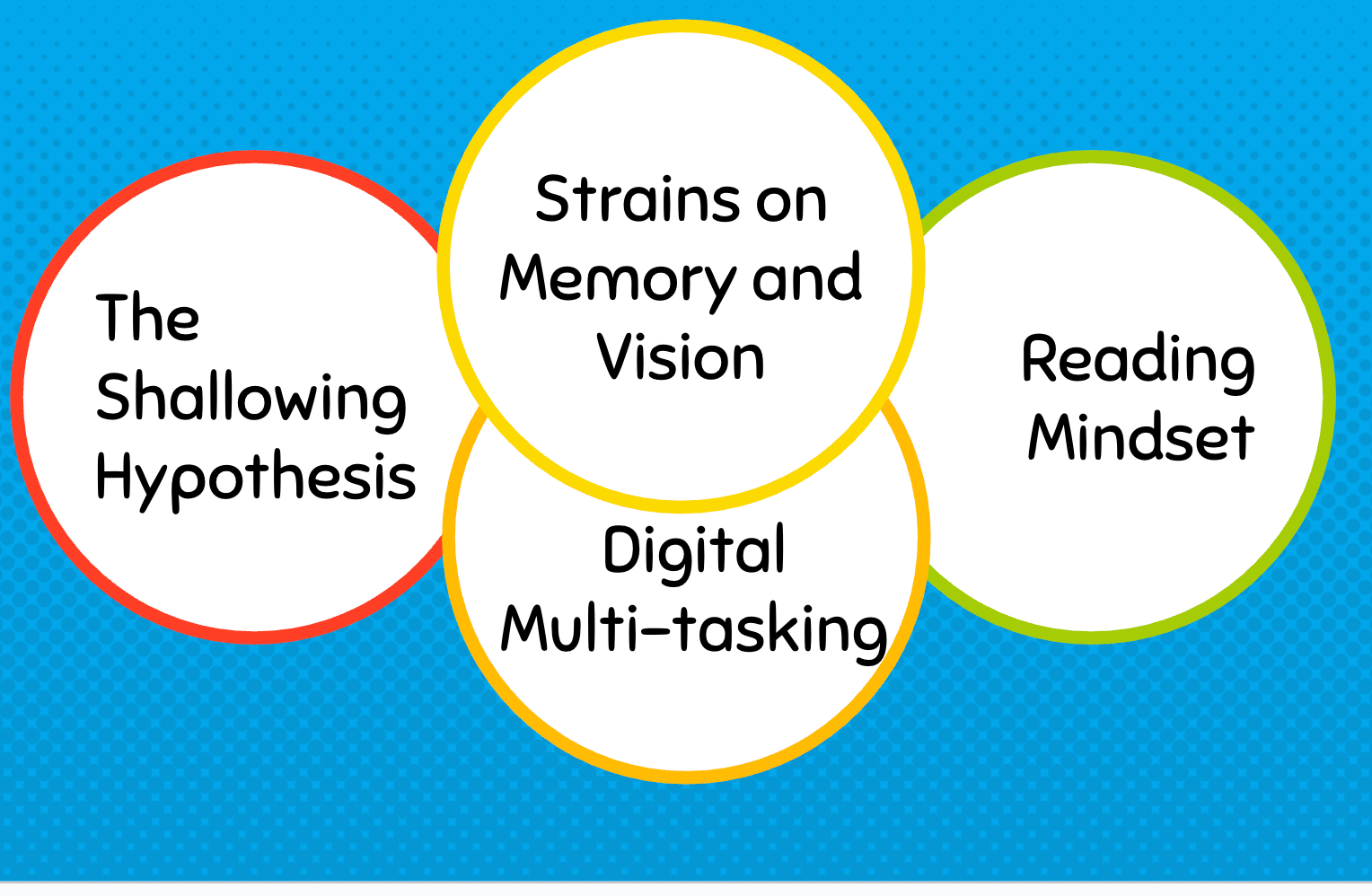
We all know everyone with a device in front them of multitasks. Studies show that people switch tasks online every few seconds. We can’t help it. Things on our screens light up and flash and chime and grab our attention. It is not surprising that we aren’t reading well or retaining what we read when our experience of reading is constantly disrupted by changing tasks.
Multitasking is a major contributor to the overall cognitive load required for reading. Further, the nature of digital media is, in and of itself, a cause of strain. Our minds cannot map digital media the way we map physical materials. When we read printed matter, we form spatial maps of the text, often remembering details in relation to one another just as we map our physical environment. One reason we can’t do that with digital media is that it is not fixed the way printed matter is. You can change the font and size, different ads appear on the sidebar now than showed up yesterday. Things on screens are constantly in flux, and that increases cognitive load. And of course the blue light has been known to cause eye strain, which causes fatigue.
The shallowing hypothesis suggests that when we read on screens, we automatically, unconsciously, start to skim. Our eyes dart around, not moving neatly from left to right but scanning for key words and main ideas, eager to scroll down the page and keep going. This sort of skimming is, by definition, shallow reading. Something about digital media puts us into a hurry-up mode where we just want to get to the point. And, to bring this back to my colleague’s bewildered freshman, unable to follow text left to right, is it any surprise, given that most of the reading kids do is on screens, where, without their knowing it, their eyes dart around instead of tracking across lines?
Finally, reading mindset, which dovetails with the shallowing hypothesis, suggests that we consciously or unconsciously assume that documents we receive digitally are less important than those we receive in print, and therefore we pay less attention to them. Like if it were really important, my teacher or boss or whoever would print it out for me.
Taken together, these challenges of screen deficit mean we humans collectively are not reading as well as used to. Even adults who grew up with good old fashioned paper have been reporting difficulty with understanding and retaining what they read since smartphones became ubiquitous.
So what do we do about it?
I obviously can’t make an argument to throw away all our devices and only use printed material. I’m sharing these thoughts with you digitally.
Perhaps, as you have been reading this, you noticed how many times you changed tabs or when you started skimming and skipping along to see if I was ever going to get to the point. And that’s fine. This little essay isn’t very important in the grand scheme of your life or mine. No harm will have been done by your skimming. Shallow reading isn’t always bad. But maybe, just maybe your consciousness of your own reading habits in our digital age has been raised. Awareness is, after all, the first step toward fixing any problem.
In addition to becoming more aware of our habits and of the ways the media we use shape our experience, there are some steps we can take.
The first thing I think we should do is carefully consider how young children use devices. I’m not a parent, and I’m not giving parenting advice. I’m a teacher, and as a teacher, I think elementary schools handing kids iPads loaded up with digital textbooks to make learning “fun” and “interactive” are making a mistake. Interactive learning games are actually weirdly passive when you start to play with them. It’s all just click, click, clicking.
Further, I do not accept any arguments that the iPad approach is a cost-saver, and even if it were, should our educational value be, first and foremost, about cutting costs? Am I the only one who still knows all the words to Whitney Houston’s “The Greatest Love of All”? THE CHILDREN ARE THE FUTURE! Teach them well and let them lead the way…
The second thing I think we must do is teach kids (and ourselves!) to navigate digital environments. What I mean is that we cannot assume they have the necessary skills to flourish in our digital age just because they were born in it. They need to know how and why taking notes by hand and reading physical documents might help them achieve better educational outcomes, and they need to know what proactive steps will help them overcome the challenges of screen deficit.
They need to practice thinking about their thinking—in other words, engaging in metacognitive processes—to accurately self assess and to figure out when shallow reading is good enough and when close reading is called for. These are things teacher and parents can work on with young people, and we must do so if we want them to thrive.
When I did my action research project, I presented my findings about screen deficit to my students, and I asked them to propose solutions we could test to overcome it. They make some solid suggestions such as using the eraser end of a pencil to track along lines of text on their computer or tablet screens to stay focused in the way you might run a finger or pencil along a line of text in a book. I love the this suggestion for the way it requires just a modicum of extra engagement and it is simple enough to actually do!
Interestingly, none of my students suggested that they could print out handouts from the teacher in order to be able to annotate them and read them in a less distracted environment than a web browser. For me, printing out important texts is a go-to approach. If I’m reading something for a grad class or to prepare materials to teach or provide editorial suggestions for a friend, and I know I need to give that document 100% attention, I print it out. When I asked my students if anyone thought printing out handouts would be helpful, they were baffled. That was allowed? They could just print things out? It never even occurred to them. Another lesson for me on how sometimes what is obvious to one is not to another.
Aside from printing out hardcopies, which is not always practical or possible, the single best strategy to read well when reading on a digital device is to take notes by hand.
I can have my laptop open and my notebook open. Now I do not have to leave the window of my digital document to take notes in a separate document, nor do I need to use clunky digital annotating tools or awkward split screen displays where everything is too small and my middle-aged eyes are straining.
By taking notes by hand, I’m also engaging more of my brain (remember what I said before about spatial reasoning and physical texts!) and am helping encode that new information into memory. And anyway, if you read last week’s post, you know how much I love creating a physical paper trail of my thinking.
Learning to read isn’t easy. For some people it is quite hard, and that’s true whether they grew up with or without screens, but screens put everyone at a deficit.
Our world isn’t getting any less digital, so we have to find ways to make sure we are using our devices in ways that serve us and our desired goals and outcomes, instead of passively letting our devices use us. Many of today’s children, digital natives though they may be, haven’t thought much about the extent to which their devices use them. They believe they are the drivers and the devices are a vehicle, but all too often the opposite is true. As the adults in their lives, it’s up to us not to be tempted to replace things that have worked really well for a long time with untested new technologies whose only real justification is that they are new.
I would love to hear your own experience adapting to our digital age. Have your reading habits changed? How do you navigate the challenges of screen deficit? Let me know if the comments!
If you’d like to read my entire Action Research report and see all my sources, you can download a copy here.